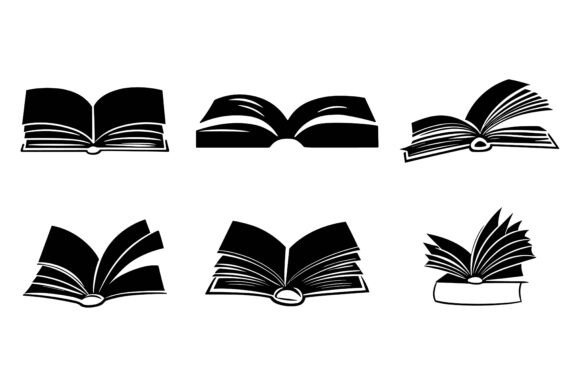
How a Vector Set of Open Book Silhouettes Elevates Your Visual Language
Few symbols carry as much universal weight as the open book. It speaks of discovery, education, stories waiting to be told, and the quiet authority of accumulated knowledge. Whether you are building a brand for a coaching business, designing an e‑learning app, or creating an infographic about reading habits, an open book silhouette can anchor your message instantly. But not all graphic resources are built alike. A Vector Set of Open Book Silhouettes, especially one meticulously crafted as an AI EPS collection, gives you more than a ready‑made picture—it hands you a flexible, professional building block that fits directly into modern creative workflows.
This is not about a single stock image you use once and then forget. It is about a carefully assembled illustration set that respects your need for speed, consistency, and uncompromising editability. With formats that bridge Mac and Windows environments, organized layers that make customization feel effortless, and a level of detail that holds up on a billboard or a smartwatch screen, these open book silhouettes are designed to grow with your project.
The Timeless Symbolism of the Open Book
Why does the open book persist across logos, icons, and editorial layouts? The answer lies in its instant readability. An open book suggests learning without saying a word. It implies transparency, a readiness to share, and a narrative arc. In branding, a startup might soften a tech-heavy logo by adding a subtle open book silhouette, instantly signalling mentorship or knowledge sharing. Publishers and libraries use it to create a sense of trust and permanence. Educators weave it into presentation decks and worksheets because learners of all ages associate the shape with growth.
But the symbol’s power also comes from its versatility. A stark black silhouette can read as classic and scholarly; a slightly softened, curved variation feels warm and approachable. That’s exactly where a vector set shines—you can take the same core shape and quickly adapt its mood through color, line weight, and surrounding composition. The open book form remains recognizable even at tiny sizes, which makes it a workhorse icon for mobile app navigation, browser tabs, and printed merchandise tags.
What Makes This Special AI EPS Collection Stand Out
You have probably downloaded free icons before only to find them locked as flat, uneditable rasters or saved in obscure formats that fight with your design software. This collection sidesteps those frustrations entirely. It arrives as an AI EPS illustration set, meaning you get native Adobe Illustrator files and an industry‑standard EPS, plus a high‑quality JPG for quick placement or previews. The files are designed for Mac and Windows users, so switching between operating systems won’t introduce odd font substitutions or broken path data.
The real magic, however, lives in the structure. Inside every AI file, you will discover a neatly organized file and layer structure. Shapes are named, grouped logically, and separated in a way that lets you jump directly to the page edges or bookmark ribbon and modify it without hunting through dozens of unnamed paths. This might sound like a small courtesy, but anyone who has wasted an afternoon clicking through “Layer 23” will know it’s a productivity multiplier. When you need to change the silhouette’s color from charcoal to a brand’s specific teal, you select the right layer, adjust the fill, and move on. No clipping masks, no mysterious rasters hiding behind vectors.
From Static Images to Fully Editable Building Blocks
The last decade has pushed design toward systems thinking. We no longer create a single flyer; we create a visual language that needs to live on Instagram stories, website headers, printed posters, and conference badges. A rasterized open book image would falter across that variety—either too pixelated for print or too in flexible to match a changing color palette. A well‑constructed vector set solves all of that with infinite scalability and a format that encourages ongoing modification.
The AI EPS format is particularly valuable for practitioners who care about perfection in details and consistency. You can open the file, zoom into the corner of a page, and see a clean, mathematically smooth curve. If you need to thicken the book’s spine or widen the pages for a bolder icon, a few node adjustments do the job without leaving behind ghost artefacts. This level of control is essential when the silhouette interacts with other elements—text wrapping around the open book on a book cover, for instance, demands precise spacing that only a vector original can deliver.
Seamless Integration Across Platforms
The combination of AI, EPS, and JPG files ensures you are covered from sketch to final delivery. On Windows, the EPS opens reliably in CorelDRAW or Affinity Designer; on a Mac, Adobe Illustrator and even free tools like Inkscape handle the format gracefully. The included JPG gives you a quick‑render alternative for mock‑ups or social media posts where you don’t want to open a full‑fledged vector editor. This cross‑compatibility means team members who prefer different software can still contribute without format conversion headaches.
Practical Applications Across Industries
A versatile symbol demands diverse uses, and an organized set encourages you to stretch its possibilities. Here are some realistic ways these open book silhouettes are being embedded into daily work:
Print Design and Publishing
From self‑published book covers to library event flyers, the silhouette provides an immediate clue about the content. Because the files are vector‑based, you can scale the open book to dominate a poster or tuck it into a corner colophon without losing edge definition. Printers appreciate the clean paths that avoid banding or unintended transparency issues. When you need to adjust the spine thickness for a 400‑page novel versus a children’s board book, the organized layers let you isolate and nudge individual shapes in seconds.
Digital and Web Experiences
Online learning platforms, coaching portals, and reading tracker apps rely on iconography that users interpret at a glance. An open book silhouette scaled down to 24×24 pixels remains legible, especially when you refine the stroke weight inside the AI file. Retina displays demand 2x or 3x resolution, but vector output never blurs. The same SVG you export from the set can become a crisp React component or a clean PNG sprite. And when the UI moves to dark mode, you simply flip the fill color to a light tone—no need to hunt for a new asset.
Infographics and Data Visualization
Statistics about literacy rates, curriculum hours, or reading habits leap off the screen when paired with a well‑placed book silhouette. You can color‑code different books to represent categories, stack them to show volume, or arrange them into a circular pattern that draws the eye. Because the set allows you to edit it, change colors and modify the icon so easily, you can generate a whole family of coordinated icons from one master file. That kind of consistency across an infographic signals professionalism and respect for your audience’s time.
Branding and Identity Systems
Startups often build their visual identity around a single metaphor, and the open book—inviting, stable, knowledge‑forward—fits many service‑based businesses. A coaching brand might pair the silhouette with a modern serif wordmark. Adjust the silhouette’s color to match the primary palette, then export variations for the favicon, social avatar, and printed stationery. From business cards to email signatures, the same vector source keeps the shape unmistakably consistent. When you later need a lighter, outlined version for a dark background, you can create it by modifying the stroke attributes in the original file, preserving the exact proportions.
Why Designers Are Embracing Editable Asset Collections
The shift toward subscription‑based stock libraries has given us an ocean of assets, but many are generic, poorly organized, or locked into proprietary licensing. There is a growing counter‑trend: intentionally curated, editable collections that treat the designer’s time as valuable. A set like this one, with its neatly organized file and layer structure, aligns with that movement. Instead of starting from a random sketch, you begin with a solid, professionally built silhouette and then bend it to your purpose.
This matters especially in fast‑paced environments—marketing agencies, in‑house design teams, and solopreneurs who must produce weekly content. When a client requests “an open book icon, but make it more approachable,” the designer can open the AI file, round the corners of the pages slightly, add a gradient, and present the update in minutes. That level of responsiveness builds trust and often leads to more creative exploration, simply because the barriers to trying something new are low.
Getting the Most Out of Your Open Book Silhouette Set
Beyond the obvious recoloring and scaling, these silhouettes can be combined, fragmented, and reimagined. Here are a few practical recommendations:
- Create overlapping compositions: Duplicate the silhouette, offset it slightly, and apply a different opacity to suggest depth or a reading pile.
- Use the shape as a mask: Fill the silhouette with a photograph of a library interior or handwritten text for a textured, editorial look.
- Build pattern swatches: Arrange multiple book silhouettes into a seamless pattern for wrapping paper, website backgrounds, or fabric design.
- Combine with typography: The open book shape often works as a container for letters—think of a drop cap “O” formed by the spread pages.
Because the source file is layered and clean, these experiments don’t leave you with a tangled mess. You can always return to the original structure, duplicate an artboard, and push the concept further.
A Small Step That Transforms Your Visual Output
Visual communication asks for both clarity and personality. An open book silhouette can deliver the former, but without editability, it often lacks the latter. When the silhouette arrives as part of a thoughtful AI EPS collection, you are no longer choosing between a generic symbol and hours of custom vector work. You get a head start that respects your skill and adapts to your process, whether you are on Mac or Windows, designing for print or web, crafting symbols, apps, or infographics.
The collection’s focus on perfection in details and consistency means that every curve, every line weight, and every anchor point has been considered. You can trust that what looks good on your screen will look equally sharp in print and that your modifications won’t break the geometry. It’s the kind of resource that quietly raises the baseline quality of all your outputs.
So why wait? Bring the enduring power of open book silhouettes into your next project. Buy now and start making this awesome illustration work for you today.