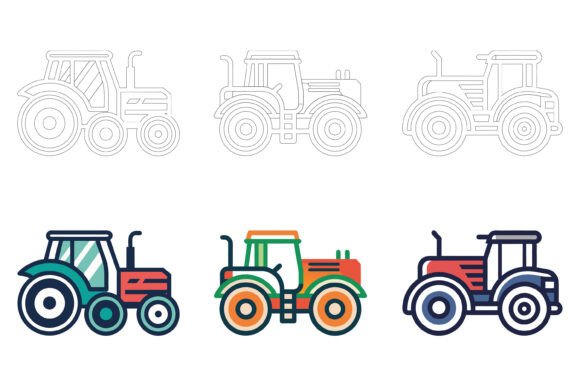
Farm Tractor Icons Set: A Specialized Vector Asset for Practical Use
In the visual landscape of modern communication, specific iconography serves as a direct conduit to industry knowledge and audience expectations. The Farm Tractor Icons Set exists within this context as a specialized collection of vector illustrations designed for professional use. It is not merely a decorative graphic pack; it is a practical asset built to address a clear need for agricultural, educational, commercial, and editorial imagery.
Purpose and Immediate Value
This set provides a coherent visual library centered on farm machinery. Its primary value lies in its ability to standardize imagery across projects requiring agricultural themes. For a marketing agency creating a campaign for a tractor manufacturer, an educator developing a module on modern farming, or a publisher producing a textbook, sourcing individual, disparate icons is inefficient. This collection offers a consolidated solution. The farm tractor icons set delivers a foundational toolkit, enabling users to bypass the time-consuming process of creating or aggregating these assets from multiple sources, which often results in inconsistent styles and quality.
Key Characteristics and Technical Specifications
The set is offered as an Adobe Illustrator EPS file alongside a JPG preview. The EPS format is the critical component, as it contains the editable vector data. Compatibility with both Mac and Windows operating systems removes a common barrier for collaborative teams using different platforms. The promise of a neatly organized file and layer structure is a significant professional consideration. In practice, a well-structured EPS file allows a designer to quickly isolate, select, and modify specific elements—like an individual tractor component or a background element—without laborious manual selection. This directly impacts workflow efficiency.
Design Integrity and Application Flexibility
Two stated strengths are "perfection in details and consistency" and suitability for diverse media. Consistency across icons—in line weight, style, perspective, and detail level—ensures that when used together, they form a unified visual language. This is essential for creating infographics, signage, or application interfaces where icon cohesion supports user comprehension. The suitability for print, web, symbols, and apps speaks to the technical quality of the vectors; they should scale without loss of resolution, a fundamental requirement for assets used across multiple outputs.
The editable nature of the vectors is arguably the set's most valuable feature. The ability to change colors and modify icons easily aligns with real-world project demands. A brand may need the icons in its specific color palette; an app developer might require a simplified version for a smaller UI element. This flexibility transforms a static asset into a adaptable resource. However, the extent of this ease depends on the user's proficiency with vector software like Adobe Illustrator. While the organized layers aid the process, modification still requires a basic understanding of the tool.
Analysis of Real-World Performance
In a professional workflow, the farm tractor icons set performs as a time-saving foundational element. A designer tasked with creating a farm safety brochure can immediately implement clear, recognizable machinery icons rather than starting from scratch. The reliability hinges on the accuracy and clarity of the illustrations. Do the icons accurately depict modern tractor features? Are they stylized in a way that remains universally recognizable? This determines their effectiveness.
For long-term value, such a set becomes part of an organization's or individual's digital asset library. Once acquired, it can be deployed across multiple projects over years, provided the style remains relevant. The initial cost is weighed against the recurring benefit of ready-to-use, editable assets, often proving economical compared to commissioning custom illustrations for each new need.
Primary Beneficiaries and Project Scenarios
Several user groups stand to gain tangible benefits from this asset set. Marketing professionals and graphic designers working within the agricultural sector—for equipment companies, agribusinesses, cooperatives, or farm-to-table brands—will find direct application in advertisements, websites, presentations, and promotional materials. Educators and educational content publishers can use the icons to create clear visual aids, textbook diagrams, and online learning modules. App and software developers focused on farming management tools, simulation games, or agricultural logistics may utilize the icons as UI elements.
Furthermore, freelancers and small business owners in rural communities—such as those running a farm supply store or a local agricultural tourism website—can leverage these professional-grade icons to elevate their visual communication without a large design budget. The set is less likely to be useful for generalists without a specific thematic need, as its value is niche by design.
Practical Recommendations and Considerations
Before acquisition, a user should evaluate their specific requirements. Assess the stylistic fit: do the icons align with the existing visual tone of your projects? Consider the scope: does your project require the breadth of icons offered, or would a more generic set suffice? A limitation could be stylistic specificity; if your brand requires a highly minimalist or photorealistic style, this pre-made set may not integrate seamlessly without significant modification.
It is also prudent to verify the technical claims. Upon receipt, check the layer organization and test the editability of a few key elements to confirm the file's integrity. Effective use involves planning: extract the icons you need, adapt them to your color scheme and size specifications, and integrate them with your other design elements. They are a component, not a complete solution.
Final Assessment of Fit
The farm tractor icons set is a purposeful and practical tool. Its worth is not based on novelty but on utility. For any professional, creator, or educator whose work routinely intersects with agricultural imagery, it offers a credible shortcut to consistent, scalable, and adaptable visuals. It mitigates the inconsistency and time cost of piecing together imagery from various sources. However, its value is contingent on a genuine need for its thematic content and a basic capacity to manipulate vector files. If those two conditions align with a user's situation, this specialized collection presents a straightforward and efficient resource worthy of consideration for integration into a productive workflow.